GtPGKogPYT4p61R1biicqBXsUzo" /> Google+ I Smell Sheep: LindaAnn LoSchiavo
Showing posts with label LindaAnn LoSchiavo. Show all posts

Sunday, October 23, 2022

Poet LindaAnn LoSchiavo: The Importance of Writing the Historical Witch Poem

The Importance of Writing the Historical Witch Poem
Historical witches and suicides get a bad rap. Instead of media coverage exploring the human being’s life, the point of fascination becomes the gruesome finale. In the case of a suicide, the where and how to provoke the most curiosity. Pills? Drowning? Asphyxiation? As one example, singer-author Susannah McCorkle was accorded far more news coverage for her dramatic leap from her Manhattan balcony at age 55 than for her entire career.

So-called “witches” fared even worse since their lives were extinguished by others due to Britain’s Witchcraft Acts or the 1692 persecutions in Salem, Massachusetts when at least 200 men and women were on trial for practicing “the devil’s magic.” Twenty were executed.

In New England, the first locals to be called “witches” were Tituba Indian (c.1680 – c.1693?), Sarah Good (1653 – July 19, 1692), and Sarah Osborne (c. 1643 – May 10, 1692). All three females were considered to be social outcasts –though for different reasons. Tituba had been purchased as a slave in Barbados and brought to the Massachusetts Bay Colony.Sarah Good was the daughter of a well-to-do tavern owner who had committed suicide; when his lavish estate was divided among his widow and two sons, the law left seven daughters with a mere pittance. In contrast,Sarah Osborne was a wealthy widow who purchased the freedom of an indentured servant and wed him, an act that violated the town’s norms.

What saved Tituba’s life was her willingness to “confess,” giving testimony about “a coven” in Salem. Eventually set free and sold again, Tituba’s story ended. “She disappeared from the historical record from that point on,” according to historian Veta Smith Tucker.

Reclaiming the life history of long-ago witches is never an easy matter for researchers. Nevertheless, this has merit for its own sake and might even counterbalance the injustice. Poets, writers, musicians, and historical societies can make a difference.

Fortunately, others share my viewpoint about the need for legacy management.

Poetic lyrics of “Sarah Good” by the South Carolina metal band "Buried Voices" commemorate the 39-year-old woman who died in her prison cell instead of “confessing.”
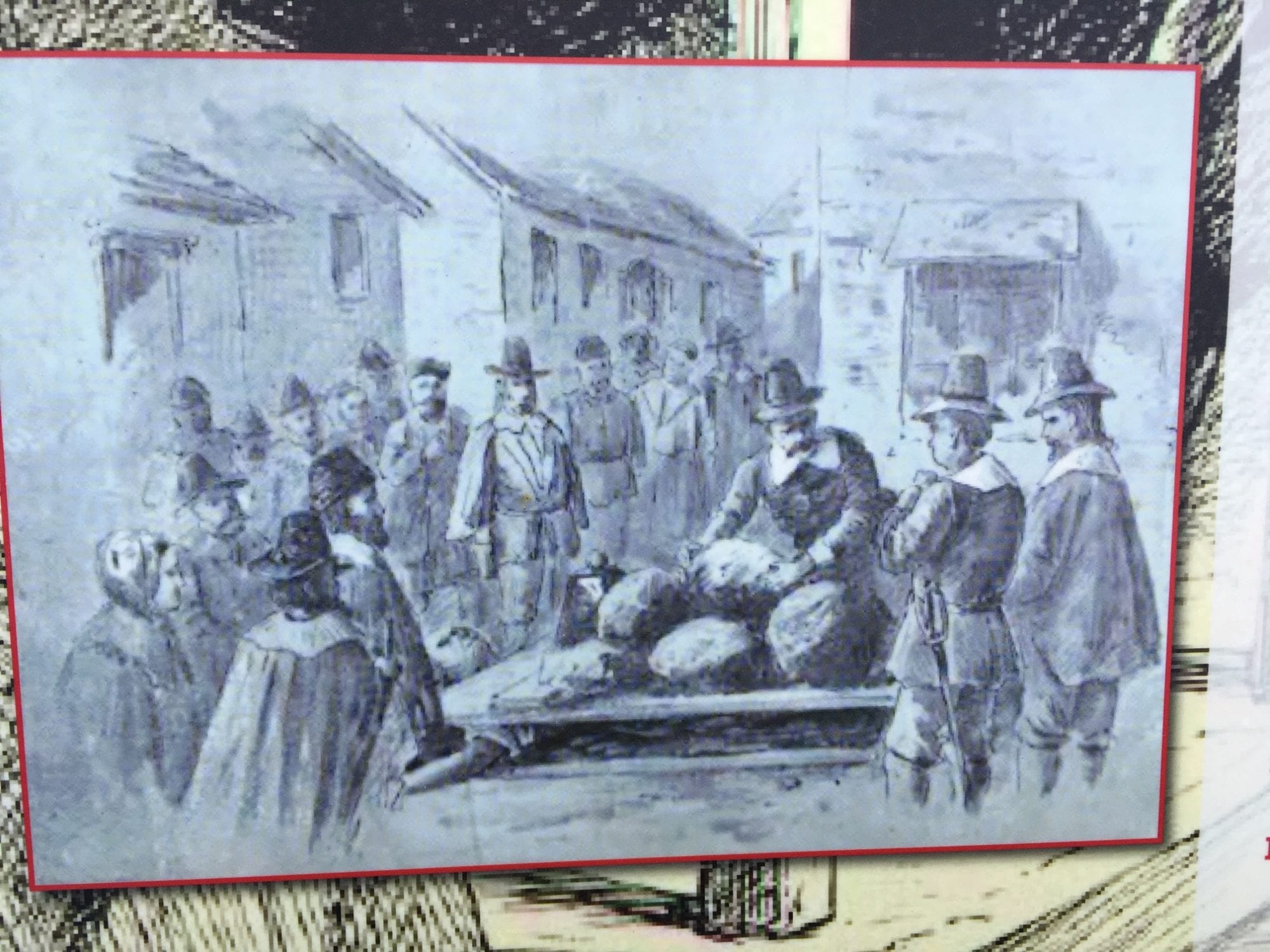
Thanks to the Peabody Historical Society, the last two victims of Salem’s witch hunting, farmer Giles Corey (c. August 1611 – September 19, 1692) and Martha Corey (c.1619 – September 22, 1692) have their own memorial at Salem Farms (now Peabody). The 150-acre property the Coreys had once owned has been revitalized through a multi-year project completed in November 2018. In addition to a large fountain, two docks, a gazebo, and picnic tables, there are two memorial stones for Giles and Martha Corey along with new signage telling their life stories and explaining the unfair verdicts and cruel deaths they faced.

Perhaps ashamed about this miscarriage of justice, Salem judges decided they would no longer accept “spectral evidence” during a trial, which brought accusations to an abrupt halt in Massachusetts. And though magistrates in Connecticut and New York were disinclined to punish an adult accused of witchcraft, level-headed tolerance did not extend to townsfolk who were quick to shun or harass anyone who was outspoken, reclusive, or different– such as Hulda, known as “the Westchester witch.”
 
A plain-faced, unmarried Bohemian immigrant who lived alone in the woods, Hulda inspired gossip and awe throughout Westchester County. In the third paragraph of “The Legend of Sleepy Hollow” (published in 1820), Washington Irving refers to her: “Some say that the place was bewitched by a High German doctor, during the early days of the settlement…”The foreigner’s keen knowledge of medicinal herbs and frequent trade with native indigenous tribes made her the object of constant speculation among the Dutch villagers. “He was a brave man who passed the cottage of the witch, even in the daytime,” wrote historian Edgar Mayhew Bacon in “Chronicles of Tarrytown and Sleepy Hollow” (published in 1897).

Fortunately, even modern storytellers refused to let Hulda’s deeds go unnoticed. Her reputation grew with the popularity of current books such as Jonathan Kruk’s “Legends and Lore of Sleepy Hollow and the Hudson Valley” (published in 2011), which devoted a chapter to the “witch of Sleepy Hollow.” Tourists would congregate at Old Dutch Church, puzzled that Hulda had no memorial there, irate that no sign was posted near her former cabin by Spook Rock.

Finally, the historical society made amends. According to The Times-Union newspaper: In 2019, a headstone, crafted in the style of an 18th-century monument with a winged soul soaring above her name, was erected at the Old Dutch Church burial ground, remembering “Hulda of Bohemia” who “died c. 1777. Herbalist, Healer, Patriot. Felled by British while protecting the Militia. Buried here in gratitude for her sacrifice.”
Take a moment to appreciate the irony herein.

Fictional witches come in many forms—good and bad, Witches of the East and Witches of the West, Baba Yaga, Sabrina, etc. — and yet all are appreciated because of supernatural abilities invested in them by wordsmiths. When a poem or story includes a witch, power is the key factor that sets the character apart. In contrast, society did Hulda and others wrong because they had no power.

In her article for Tor, Sarah Gailey expanded upon this concept: “When we write witches, we are writing about our expectations of women, and what we hope—and fear—they would do if they had access to power. Fictional witches act as ciphers that help us understand something that seems at once mysterious and brilliant and sinister: a woman’s ultimate, unlimited potential… realized.”

Bewitchment is also on the mind of Fire Lyte, a Simon and Schuster author who has interviewed self-identified witches as well as fairy experts, paranormal investigators, etc. on his podcast “Inciting A Riot.” In an article for Writer’s Digest, Fire Lyte explained: “The witch is typically portrayed as having eschewed societal norms and found power elsewhere that allows them to right wrongs and reach an equity they’ve previously been denied.”

Several poems on historical witches are in my manuscript, “Always Haunted.” The pen is mightier than life stories crumbled into anonymous dust. The act of writing resuscitates a historical witch. I encourage readers to dig into the archives, find your witches, and let them breathe, dance, and charm on the page.

Messengers of the Macabre: Halloween Poems
LindaAnn LoSchiavo, and David Davies
18th October 2022
Genre: Poetry
Publisher: Nat 1 Publishing LLC
ASIN: B0B3NK7QG6
Number of pages: 49
Word Count: 6,400 approx.
Cover Artist: Benyamin Agum
Your portal to the dark side

All Hallows’ Eve, Samhain, Day of the Dead… during this interval, the barriers between the two realms are thinnest. Normal turns paranormal; what's natural becomes the supernatural. That's when the messengers of the macabre are in their rightful element.

Step inside this collaborative chapbook and embrace a haunted harvest of verses embracing bewitchment, boneyards, and all things that go... BOO!

About the Author:
LinkTr.ee
Native New Yorker LindaAnn LoSchiavo, a Pushcart Prize, Rhysling Award, Best of the Net, and Dwarf Stars nominee, is a member of SFPA, The British Fantasy Society, and The Dramatists Guild.

Elgin Award winner “A Route Obscure and Lonely,” “Concupiscent Consumption,” “Women Who Were Warned,” and “Messengers of the Macabre” by Audience Askew [October 2022] are her latest poetry titles.

Up next: a tombstone-heavy collection in hardcover by Beacon Books.

She has been leading a poetry critique group for two years.

Her Texas Guinan film won “Best Feature Documentary” at N.Y. Women’s Film Fest (Dec. 2021).

Sunday, October 16, 2022

Messengers of the Macabre: Halloween Poems LindaAnn LoSchiavo, and David Davies + giveaway

Messengers of the Macabre: Halloween Poems
LindaAnn LoSchiavo, and David Davies
18th October 2022
Genre: Poetry
Publisher: Nat 1 Publishing LLC
ASIN: B0B3NK7QG6
Number of pages: 49
Word Count: 6,400 approx.
Cover Artist: Benyamin Agum
Your portal to the dark side

All Hallows’ Eve, Samhain, Day of the Dead… during this interval, the barriers between the two realms are thinnest. Normal turns paranormal; what's natural becomes the supernatural. That's when the messengers of the macabre are in their rightful element.

Step inside this collaborative chapbook and embrace a haunted harvest of verses embracing bewitchment, boneyards, and all things that go... BOO!


Ritual
These men got what they deserved.

She looks down at the fresh grave,
breathing the sour odors of wet earth
and the recent sweat of the diggers.
Dressed in mourners' black, naturally.
Far from the smoky lanterns of the street,
the meat roasting on the stoves,
and the violence and money
men waste on brief entertainment.

She’s the youngest; her sisters and
mother always know where she is.

In front of her, three short steps beyond
the dark soil, is the wooden cross
with the neatly carved name.
The carpenter here does fine work.

She rubs a swollen lip. It will heal
and fade like the others, and this one
will not leave a scar. They all,
mother and sisters, bear record
on their skin from men like this one.

These men deserved what they got.

You’re the one that makes it right,
her sisters tell her. You were born knowing
where to cut, they admire. Our angel
sent to protect us. Small and quick,
shadow-to-shadow, under dim windows,
too clever to be seen, the deed done
swiftly by a small hand and a sharp
thin blade where no one looks.

And when suspicion arises?
“She’s the baby, we don’t let her out.”
“We always know where she is.”

What more can women do
but protect each other?

Knife in hand now, she steps forward.
The turned earth gives a little
under her boots. One hand on top
of the cross, she hacks at the letters.
They splinter and crack, until
there is bare wood cleaved and cut
where a name once stood.

These men deserve what they get.
She’s the baby, her mother and sisters
always know where she is.

Then she’s gone in her black dress
before any—alive or dead—can notice her,
this cemetery ritual complete.

About the Authors:
Website
New York City necromancer LindaAnn LoSchiavo, a wily clairvoyant, honed her psychic abilities during childhood and has the power to haunt any benighted soul who disparages this chapbook.

Some of her Elgin Award-winning poems have been seen here: Bewildering Stories, Blood ‘n Bourbon, Mermaids Monthly, South Broadway Ghost Society, Star*Line.

Formidable dragon slayer David Davies left Wales under baleful circumstances for The Lone Star State. “Have sonnets, will travel,” announces his business card.

His Pushcart- and Bram Stoker-nominated poems and stories have been known to appear in: Granfalloon, Green Lantern Press, MacroMicroCosm, Moon Shadow Sanctuary, Ripples in Space.

Spooktacular Giveaway
1 ebook copy of Messengers of the Macabre: Halloween Poems by LindaAnn LoSchiavo and David Davies and some of digital artwork