GtPGKogPYT4p61R1biicqBXsUzo" /> Google+ I Smell Sheep: amwriting
Showing posts with label amwriting. Show all posts

Sunday, December 17, 2023

10 Tricks for Writing During the Holidays by Loren Rhoads + giveaway


10 Tricks for Writing During the Holidays
by Loren Rhoads

Sometimes, especially around the holidays, it’s hard to find time to do the creative work you want to do. I’ve used a bunch of tricks to carve out time to write. I hope these will inspire you.

1. Make a list. Whether it’s topics you want to explore or scenes that need to be written, it’s easier to begin writing when you have a prompt.

2. Set an alarm. Promise yourself that you will settle down to write as soon as the alarm goes off. Giving yourself the anticipation of writing time can be inspirational.

3. Set a timer. Anyone can write for 15 minutes. There’s something about the tiniest amount of time pressure that tricks your brain into thinking it’s on a deadline. Start a timer on your computer, phone, or in the kitchen. You might find yourself pounding out the words to beat the bell. If the words are really flowing, you can always add a second 15-minute sprint.

4. Make a date with a friend. Whether you sit down together in a cafe or meet online for a video chat, it really helps to know that someone else is working alongside you. The key is to find someone who will write, rather than chat.

5. Put your headphones on. Many writers make a playlist that they listen to only when they work on a particular project. Listening to the same music every time you write can train your brain to provide inspiration on command.

6. Write somewhere else. If you normally write at a desk, try moving to the sofa or the kitchen table or sitting in bed. The simple act of shifting to new surroundings can shake loose the words.

7. Try a different writing tool. Do you usually write on a laptop? Try writing by hand in a notebook or attach a keyboard to your phone. Some writers swear by word processing keyboards like AlphaSmart or FreeWrite, which only allow you to see a small amount of the text you’re working on. That way you're forced to move forward, rather than editing what you've already done.

8. Write first thing in the morning. It’s tempting to start the day by checking email or scrolling social media, but what might you come up with if you listened to your own thoughts first thing in the morning?

9. Write last thing at night. Take a notebook to bed and draft one more scene before you turn out the light. Do the words feel different as you’re settling in for the night? Maybe your subconscious can solve a writing problem for you in your dreams.

10. Chart your progress. Whether you put a check on the calendar, color in a box on a habit-tracking chart, or note your word count in your planner, record the days you write. It’s addictive to see your progress.

What other tricks have you found for getting the work done? Make your own list, so you'll have some tools to use next time you feel at a loss for words.

Spooky Writer’s Planner
by Loren Rhoads and Emerian Rich
Genre: nonfiction planner
Publisher: HorrorAddicts.net
Date of Publication: November 2020
ISBN: 9798560168698
Number of pages: 361
Cover Artist: Emerian Rich
Get organized this year!

Are you a horror author who wants to take your career to the next level? Do you write dark fantasy, paranormal romance, spooky poetry, or morbid nonfiction?

Would you like to advance farther in the direction of your dreams?

The Spooky Writer's Planner includes:
13 months of monthly and weekly calendars
Monthly goal and recap sheets
Weekly check-ins and note pages
Writing challenges, prompts, and brainstorming pages
Trackers for submissions, pitches, and contacts
Marketing, newsletter, and blog planners
Check-off sheets for website maintenance, social media updates, and expenses

Available in Digital and Print
Book Trailer: https://www.youtube.com/watch?v=SkAATjLixjE
See An Excerpt Here: https://dl.bookfunnel.com/noi4i2rset


The quick-download version gives you a digital copy so you can print the pages you need and print multiples of those you'll use the most. Create your own Frankenstein's Monster of a planner! These black & white pages are designed to be printed on 8.5 x 11-inch paper. Put them in a three-ring binder or bind them with disks or a spiral, your choice. Use it year after year after one purchase!

Available from Etsy

The Spooky Writer's Planner is perfect-bound with a glossy cover, printed on high-quality 8.5 x 11-inch paper. Everything you need is included in one handy book that you can grab and go!

Available from Amazon


About the Author:
Website-FB-Twitter
Blog-Instagram
Newsletter
Goodreads-Amazon
Loren Rhoads is the co-author of Lost Angels and Angelus Rose -- the As Above, So Below duology -- with Brian Thomas. Loren's stories about the succubus Lorelei have appeared in the books Sins of the Sirens, Demon Lovers, and Unsafe Words, and most recently online at The Fabulist.


 1 copy of the digital Spooky Writers Planner to anywhere in the world.

a Rafflecopter giveaway

Monday, November 26, 2018

Ink Well--One writer’s process explained for the reader with Christina Bauer

As part of the launch tour for my new book SCYTHE, the lovely folks at I Smell Sheep have asked me to share one key insight on my creative process with their readers. And verily, there is a tidbit I’d love to share:

It’s Okay To Suck At Writing. Seriously.

Here’s the deal. Want to be a writer someday? Then have I got news for you: believe it or not, it's okay to suck at writing. Really. And for the record, I'm not talking about 'wow that paragraph could maybe get reworked' suck. I'm talking serious, top-of-the-line, vacuum-cleaner-that-picks-up-bowling-balls-level of suckage, and for a really-really-really long time.

And no, I am not kidding.

In fact, such awfulness is typical and, if handled properly, a sign of great things to come.

Still not kidding.

Here's my story on this subject. I didn't speak until about five, but once I started, I loved to tell stories about the worlds in my head. My first was an elaborate multi-generational quest set in a world inspired by the game Candyland (the bad guy lived in a chocolate palace). Soon, I was sharing these stories at school---during class, unsolicited---to the point where the nuns had to set aside 'special story time' for me so I'd shut up for most of the day (yeah, I was that kid). Once I got the knack of writing, I compulsively penned my tales instead, much to the nun's joy. Later, when it I hit upper grade school, English class was my personal bitch.

Oh, how I thought I rocked.

And lo, Freshman year of High School arrived. With it came more nuns and my first big-girl High School English paper. Man, I worked hard on that sucker. I handed it in and waited with baited breath for the inevitable 100 to come back, the page littered with side notes on my awesomeness. Sure enough, the paper came back, but not with a 100 on the top.

I got a 67. Not a total failure, but pretty darned close. Whoa.

'Devastated' pretty much describes my reaction to this 67. My life was predicated on the concept that I rocked at writing. Now, this seemed no longer true. Even worse, there were kids in my very same class that got perfect 100's on their first paper. Holy shit. They were better than I was. At. Writing.

This launched some major soul searching. I debated about never writing again, for reals. I felt mightily crushed and lied to...what were all those accolades in years gone by? What silly, torturous games were the nuns playing with me in grade school? This mope-fest went on until I eventually pulled up my big girl panties and went back at it, working hard for a better grade. This was Freshman year. I didn't get a 100 on a writing essay until I hit Senior year of English. So there you go.

When I got to college, I had no problems getting good grades, but there were other shocks in store. I met some other writers who were so freaking amazing, it made me want to drop writing again. For example, one kid I met Freshman year wrote his essays in iambic pentameter because, well, he was bored. Bored, I tell you! And it was goooooooood stuff. Like, I could work for weeks and not come up with two lines that were half as lovely. I don't know where that kid is now, but I wouldn't be surprised if he hit his own version of a '67' at some point, just like I did, and had to face the question: now that I have to work my ass off for this, is this still worth it?

Now, the 'worth it' conundrum isn't really a question anyone can answer for you, especially when it comes to writing. That said, at the time, I think it might've helped moi to know that the cycle of sucking-to-getting-better is pretty typical. In fact, it's a sign that your work is growing, and that's not just okay, that's amazing.

Today, I sincerely hope that every book I write kicks the ass of my last one.

Because, at the end of the day, that kind of suck is awesome.


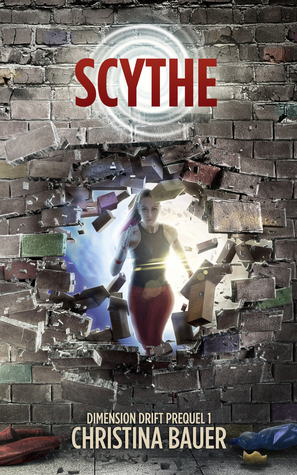
Scythe 
(Dimension Drift Worlds, #1)
by Christina Bauer
 April 24, 2018
Genres: Dystopian, Fantasy, Young Adult
“Fans of A Wrinkle in Time can’t missDimension Drift!” – Christina Trevaskis, The Book Matchmaker

Truth time. I go to a Learning Squirrel High School. Don’t judge.

On second thought, judge away. Learning Squirrel is one step above attending class in a junkyard. But what do you expect? Everything’s made out of garbage these days. At least, I have my freelance work to keep Mom and me housed, clothed, and fed. How? I’m your regular high school science geek for hire, except my work manipulates space-time. The good news is that these gigs pay really well; the bad news is that the government likes to kill people like me. Whatever. I’m not worried; hiding from their detection systems is easy for me.

Then I screw up one of my illegal projects. Badly.

In fact, things go so sideways that my house slips into two-dimensional space-time. The shift only lasts for a few seconds, but that’s long enough to set off a dozen government alarms. If those goons track me down, Mom and I are as good as dead. Long story short, I need to pay someone off, hide the evidence, and keep us safe.

Unfortunately, that means asking the Scythe for help. He runs the local underground crime scene and has absolutely no conscience…Or at least, I’m pretty sure he doesn’t. It’s hard to think straight when a guy’s that hot in an ‘evil Mafioso kingpin’ kind of way. Most importantly, the Scythe is a crime lord who can conceal my slip-up with a few clicks on his minion’s computer keyboards. But the man has his price. In this case, the Scythe wants me to finish a certain dimensional prototype for him in twenty-four hours. I can do it, but it might mean Learning Squirrel High gets blown up in the process. Oh yes, and there’s also my new hot classmate who may or may not be an alien…and he says he’ll do anything to help me.

This job won’t be easy, but I’ve gotten out of worse scrapes. Maybe.

About the Author:
Website-FB-Twitter
Christina Bauer knows how to tell stories about kick-ass women. In her best selling Angelbound series, the heroine is a part-demon girl who loves to fight in Purgatory’s Arena and falls in love with a part-angel prince. This young adult best seller has driven more than 500,000 ebook downloads and 9,000 reviews on Goodreads and retailers. The first three books in the series are now available as audiobooks on Audible and iTunes.

Bauer has also told the story of the Women’s March on Washington by leading PR efforts for the Massachusetts Chapter. Her pre-event press release—the only one sent out on a major wire service—resulted in more than 19,000 global impressions and redistribution by over 350 different media entities including the Associated Press.

Christina graduated from Syracuse University’s Newhouse School with BA’s in English along with Television, Radio, and Film Production. She lives in Newton, MA with her husband, son, and semi-insane golden retriever, Ruby.

Stalk Christina On Social Media – She Loves It!


Giveaway:
Tour-wide giveaway (INTL)
A paperback copy of Scythe & more!

Wednesday, June 13, 2018

Ted Neill: Ink Well--Want to write something good? Then take time NOT writing.

Want to write something good? Then take time NOT writing.

One of the most confusing but important things one of my writing mentors once said to me was: The time you spend NOT writing is just as important as the time you actually spend writing. Said another way, every work of writing is a combination of the time spent writing and the time spent thinking about the writing, whether consciously or not (often not).

So here are my ten steps to writing a complete work, be it a novella, novel, short story, poem, screenplay, or whatever. . .

1. Write—Randomly. On scraps of paper, envelopes, increasingly I find myself taking notes on my phone. These come at the WORST times. I find there is an inverse relationship between the ease of writing in the moment and the quality of the idea. For example, while merging into traffic, standing in the shower, or when I am about to fall to sleep at night. . .BAM I get walloped with a winner and the gearshift, bar of soap, or my Teddy Bear (don’t judge) are lousing writing instruments.

2. Take Time—To Live your Life. Go and do the thing you were doing in the first place, driving to your destination, running to work, or getting a good night’s sleep. Go gather the experience that feeds your writer’s soul in the first place. You’ll thank yourself later.

3. Write—Freely. I’m a person who likes structure so this part is REALLY hard for me. But I’ve learned that I need to take time to do character sketches, jot down scenes. They might be out of order, they might just be background experiences of characters that never make it into a single draft, but this is still an exploratory stage. Throw things at the wall and see what sticks. Don’t get in your own way. Let yourself enjoy the fun of it. Don’t stress if you don’t have a word or page count (yet) to look at, at the end of the day. This step isn’t something measured that way.

4. Take Time—For your unconscious to work. This is also a hard part for me because I’m also a person who likes control. But I’ve found that this is where the most mysterious part of the process begins for me. Having sketched out scenes, and characters in step 3, I move on. I work on other things (See Step 2). I go for a hike, I read other books, watch movies, gently feeding images, experiences, and other’s art into my brain where it (somehow) seeps into some weird place in my unconscious where the ideas germinate.

5. Write—An Outline. I remember a business major roommate of mine in college asking me if I wrote my papers using an outline. I responded, “You mean you don’t?!” But I was an English major so I took the writing process a little more seriously. Here is where I (FINALLY) start adding some structure to the story, with scenes, character arcs, maybe even initial chapter headings. Sometimes I even write summaries of the chapters on 3X5 cards and lay them out of the floor, trying different sequences is possible. Throughout the process, even up to the final stages, be open to surprises your characters might throw at you or side plots that might pop up. I still do this all in long hand.

6. Take Time—For your idea to gestate. Congratulations, you are officially pregnant at this point (or at least that is what I think of it as). Once the outline is out, for me, the story is THERE. It’s a thing and its growing. But again, I find I can never force it. Just have to let it ripen at its own pace (although I wish I could force it, when I do, it’s ALWAYS a disaster). Often, I find listening to music, reading other authors I like, watching movies, and hiking and being in nature help, not to mention getting enough sleep—some of my best ideas have also come from REM sleep (See Step 2 again). Sometimes, being a writer is like having a ghost as a business partner, you’re never quite sure when he or she is going to show up to actually do the damn work, but when they do, and the story feels ready, you know intuitively, like the hairs on your arm or the vibrations in your chest, it’s inspiration and you can’t not start writing.

7. Write—The First Draft. I write mine in longhand on college rule loose leaf. It’s slower, but it makes me think through my sentences more carefully. It also allows me to be messy. I still liken this stage to being a bit like sketching as opposed to the pressure I feel to have something more polished on a computer screen.

8. Take Time—To Walk Away! Yes, walk away! Unlike REAL babies, this one may benefit from a bit of neglect. I take a few days between completing that first draft and typing things up. Treat yourself!

9. Write—On a Keyboard. Finally, this is when I actually start typing. Note: there have been a whole lot of steps and time leading up to this. When non-writers picture you “working” this is what they picture. But that’s a disservice. The preceding steps, especially the even numbered ones, might not look like writing but they ARE. They are just as critical an ingredient and it’s important to give yourself permission, space, and time for them.

10. Take Time—To Edit. Another writing mentor once told me that “There are no good writers. Just good rewriters.” So true. So get some distance from your work while someone you trust edits it and provides you some honest feedback. I ca never edit my own stuff adequately. Good writers need good editors.

Then repeat steps 9 and 10 until ready to publish!

Jamhuri, Njambi & Fighting Zombies
by Ted Neill
February 25, 2018
200 pages
A Delight for Young Readers and the Young at Heart. A princess trapped in a high tree and a brash young man determined to “rescue” her; a devoted daughter searching for a magical spring to save her ailing father; a teenage girl who is forced to replace her mobile phone with a machete to protect her family from zombies—all their stories interweave in a stirring alchemy set in a rich African backdrop. Ted Neill moves readers from folktale to action, comedy to cosmology, rural to urban, material to spiritual, with the ease of a master storyteller, crafting an adventure along the way that will appeal to the head, the heart, and the soul.


About the Author:
website-FB-amazon
Globetrotter and fiction writer Ted Neill has worked on five continents as an educator, health professional, and journalist. His writing has appeared in The Washington Post and he has published a number of novels exploring issues related to science, religion, class, and social justice. He wrote his most recent young adult novel Jamhuri, Njambi & Fighting Zombies after living and working at an orphanage for children with HIV/AIDS in Kenya. The children he met there requested stories featuring people and places that reflected their own culture and their own world. Jamhuri, Njambi & Fighting Zombies was written for them and anyone else who might enjoy, fun, adventure, and zombies.